
Solo disponible en inglés
Does ChatGPT watermark text?
By the Clean AI Watermark teamUpdated
Short answer
On October 5, 2026, OpenAI announced that over the following weeks it will add a watermark called textGrain to ChatGPT and Codex text in the EU. The watermark is a statistical pattern in the model's word choices, not hidden characters.
What did OpenAI announce on October 5, 2026?
On October 5, 2026, OpenAI announced textGrain, a statistical watermark for AI-generated text. OpenAI said it will begin adding textGrain to ChatGPT and Codex text generated in the European Union, across all plans, “over the coming weeks.” The OpenAI API offers text watermarking separately as an opt-in feature for select models, with the setting off by default. The announcement follows OpenAI’s June 11, 2026, announcement that it supports the EU Code of Practice on Transparency of AI-Generated Content, which is intended to help implement the transparency requirements of the EU AI Act.
As of October 6, 2026, the ChatGPT/Codex rollout was not live yet: OpenAI said it would happen “over the coming weeks,” and there was no corresponding rollout entry in the OpenAI release notes.
Read OpenAI's October 5 announcement: Our approach to EU text provenance rules
Read OpenAI's June 11 announcement: Supporting Europe’s work in ensuring a trustworthy AI ecosystem
Where does the ChatGPT watermark apply?
The announced scope is:
| Product | Watermark | Since |
|---|---|---|
| ChatGPT | textGrain for generated text in the EU, across all plans | Rolling out over the coming weeks |
| Codex | textGrain for generated text in the EU, across all plans | Rolling out over the coming weeks |
| OpenAI API | Optional text watermarking for select models; off by default | Available from October 5, 2026 |
| Text generated before the rollout | No new textGrain added retroactively | No watermark added after the fact |
There are still some questions about the geographic rollout. OpenAI's announcement refers specifically to the European Union; it does not clearly say whether the watermark rollout also covers the EEA, Switzerland, or the UK. OpenAI also has not publicly explained whether regional eligibility is determined by IP address, account country, billing country, or another signal.
How does the ChatGPT text watermark work?
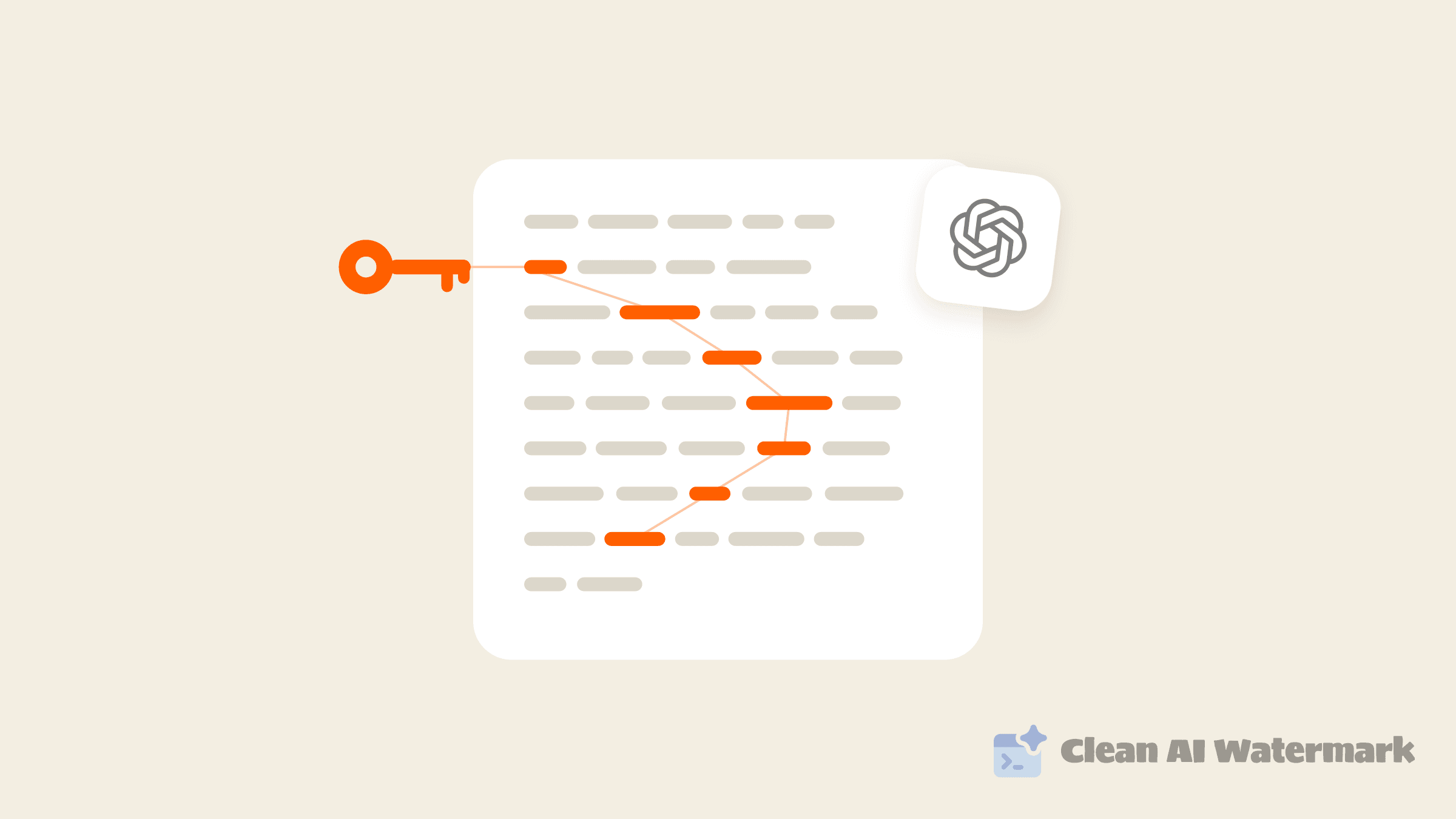
The simplest way to think about textGrain is that it changes which words the model chooses on purpose when several choices would produce similarly good text. This deliberate choice of words produces a hidden pattern in the generated text.
A secret key controls part of this word-choice pattern. One individual choice looks completely normal, but across a long passage the choices form a statistical signal that a detector with the matching key can measure.
The watermark does not contain your name, account ID, or other user identification. A detector just checks whether the statistical watermark is present in the text; it is not reading a hidden identifier about the person who generated it.
OpenAI says its own tests found no meaningful change in output quality from adding the watermark.
Read the OpenAI textGrain technical report
Is the ChatGPT watermark just hidden characters?
No. The new textGrain watermark is not a string of hidden characters. textGrain works in the choice of words, not by inserting invisible characters. That means the signal can survive ordinary copy and paste, while a tool that only removes hidden Unicode characters does not target the textGrain watermark.
The U+202F narrow no-break space story from April 2025 was about something different. Rumi reported finding U+202F characters in some ChatGPT output, and OpenAI reportedly described those characters as a quirk of reinforcement learning, not a watermark.
Likewise, there is no source that establishes em dashes as an OpenAI text watermark. Em dashes may be a writing-style habit in some AI-generated text, but they are not the mechanism OpenAI describes for textGrain.
Rumi's April 2025 report on the U+202F characters
Who can detect the ChatGPT watermark?
There is no public OpenAI text-watermark detector at launch.
OpenAI says approved researchers and expert organizations can apply for access to the text detector. Its documentation specifically mentions academic institutions among the organizations that can apply.
So, can a teacher check it? Not through a public OpenAI text checker today. A school or university is not automatically excluded, but access depends on the organization qualifying for and receiving access from OpenAI.
OpenAI's public Verify tool is different: it checks images and audio, not ChatGPT text.
Turnitin and GPTZero are also different from an OpenAI watermark detector. Their AI-writing features estimate whether text looks like AI-generated writing based on statistical/style signals; they do not have OpenAI's secret textGrain key and therefore are not directly reading the textGrain watermark.
Turnitin: Using the AI Writing Report
What weakens the ChatGPT watermark?
OpenAI's own tests show that textGrain is harder to detect in some situations.
For answers to psychology questions, OpenAI reported detection of about 80% of 200-token passages and about 95% of 400-token passages at a 1% false-positive rate. Detection was weaker for mathematics, where there are often fewer natural alternative word choices.
Editing can also weaken the signal substantially:
| Edit | Watermark detection |
|---|---|
| Original text | 92% |
| Swap about 10% of words for synonyms | 66% |
| Swap about 25% of words | 17% |
OpenAI also says that edited or translated text may be impossible to check reliably.
These are OpenAI's own evaluation results, not independent validation. As of October 6, 2026, there was no independent published test of textGrain that we could verify.
A hidden-character cleaner does not remove textGrain. It targets hidden Unicode characters, whereas textGrain is based on the statistical pattern of the words themselves.
OpenAI's textGrain announcement
What does a watermark check prove?
A missing watermark does not prove that a human wrote the text.
The watermark may be difficult to detect because the text is too short, heavily edited, translated, generated by an unsupported model, or created before the watermark was introduced.
A detected watermark also has limits. It does not tell you:
- who actually used the AI system;
- how much a person edited the text;
- whether the person copied, rewrote, or combined it with human writing; or
- whether the claims in the text are true.
A watermark check is therefore a provenance signal, not proof of authorship, editing history, or factual accuracy.
OpenAI: Our approach to EU text provenance rules
Does the OpenAI API add the watermark?
Not by default. OpenAI says API customers can opt in to text watermarking for select models, and the feature is off by default. The setting can be configured at the project or organization level. They have not yet published a fixed list of model names.
OpenAI Help Center: EU AI Act resources and customer guidance
Why is OpenAI adding a watermark now?
The immediate regulatory context is the EU AI Act.
Article 50(2) establishes transparency requirements for providers of AI systems that generate or manipulate synthetic content, including text. The relevant transparency obligations apply from August 2, 2026.
For systems already on the market before that date, the transition arrangements provide additional time, with the relevant compliance deadline extending to December 2, 2026.
The 200-token threshold comes from the EU's Code of Practice on Transparency of AI-Generated Content, rather than directly from the wording of Article 50(2). The Code provides practical guidance for implementing the transparency requirements, including watermarking approaches for generated text above the specified threshold.
OpenAI signed the EU Code of Practice.
OpenAI had also already developed a text watermarking system in 2024, but did not deploy it at the time. The company said it had concerns about factors such as circumvention and possible effects on non-native English speakers.
European Commission: Code of Practice on Transparency of AI-Generated Content
OpenAI: Understanding the source of what we see and hear online
How does ChatGPT compare with Claude and Gemini?
| Model / service | Text watermark | Scope / availability |
|---|---|---|
| ChatGPT | textGrain | EU rollout from October 2026 |
| Claude | Anthropic's statistical text watermark | Worldwide, announced August 2026 |
| Gemini | SynthID-Text | Used for text generated in the Gemini app/web experience |
Claude: Anthropic announced its text watermarking in August 2026 and described it as a worldwide system. Like textGrain, the signal is statistical rather than a visible mark or hidden Unicode character.
Anthropic: Claude text watermark
Gemini: Google DeepMind uses SynthID-Text in Gemini. It works by adjusting token probabilities to create a statistical watermark that is intended to be imperceptible to readers.
Google DeepMind: Watermarking AI-generated text and video with SynthID
ChatGPT: OpenAI's October 2026 rollout is more geographically limited: ChatGPT and Codex text in the EU, with the rollout beginning over the coming weeks. The API is a separate opt-in system and is not automatically watermarked worldwide.
OpenAI: Our approach to EU text provenance rules
Which AI models watermark text?
Clean your AI text
Paste the text and click once. Clean AI Watermark strips hidden characters, rewrites the word choices, and keeps your meaning.
Sources
Company pages
- OpenAI: Our approach to EU text provenance rulestextGrain, where it applies, and its limitsChecked
- OpenAI: Supporting Europe’s work in ensuring a trustworthy AI ecosystemOpenAI supports the EU Code of Practice, June 11, 2026Checked
- OpenAI: Verify OpenAI-generated contentChecks for images and audioChecked
- Turnitin: Using the AI Writing ReportTurnitin's AI writing detectionChecked
- Google DeepMind blog, May 2024SynthID-Text in GeminiChecked
- OpenAI Help Center: EU AI Act resourcesThe API settingChecked
- OpenAI: Understanding the source of what we see and hear onlineOpenAI's text watermark, August 2024Checked
- Anthropic: How Claude's text watermarking worksThe Claude watermarkChecked
Research and reports
- OpenAI: textGrain technical reportHow textGrain worksChecked
- Rumi: New ChatGPT models seem to leave watermarks on textHidden spaces in ChatGPT text, April 2025Checked
Law and regulators
- European CommissionCode of Practice signatoriesChecked
- Regulation (EU) 2024/1689Article 50(2)Checked