
Nur auf Englisch verfügbar
Which AI models watermark text?
By the Clean AI Watermark teamUpdated
Short answer
Claude and Gemini watermark the text they write. Both hide a statistical pattern in the model's word choices, based on Google DeepMind's SynthID-Text, and neither adds hidden characters. OpenAI is adding its own word-choice watermark to ChatGPT text in the EU over the coming weeks. Mistral plans to mark its output by December 2, 2026, an EU deadline.
Which AI models watermark text in 2026?
This table shows what each company says about its own models. Each company links to its own page. We checked each source on September 28, 2026, and OpenAI's new announcement on October 6, 2026.
| Model | Text watermark today |
|---|---|
| AnthropicClaude Help CenterChecked | |
| Claude Fable 5.1 | Yes |
| Claude Mythos 5.1 | Yes |
| Claude Opus 5.5 | Yes |
| Claude Opus 5 | Yes |
| Claude models released before August 2, 2026 | Being added, all by December 2, 2026 |
| GoogleGoogle DeepMind: SynthIDChecked | |
| Gemini app and web | Yes |
| Gemini API | Not stated by Google |
| OpenAIOpenAI: Our approach to EU text provenance rulesChecked | |
| ChatGPT and Codex in the EU | In the EU, rolling out over the coming weeks |
| ChatGPT and Codex outside the EU | No, not at launch |
| OpenAI API | Off by default, opt-in for select models |
| xAIxAI FAQChecked | |
| Grok | Not stated by xAI |
| MetaMeta NewsroomChecked | |
| Meta AI and Llama | Not stated by Meta |
| MistralMistral AI: Vibe WorkChecked | |
| Mistral Vibe (formerly Le Chat) | Planned by December 2, 2026 |
The Claude and Gemini watermarks work the same way: Claude's is a version of Google DeepMind's SynthID-Text. OpenAI's new watermark for ChatGPT also hides its pattern in the word choices, with a method of its own. The next section explains the idea.
How does a text watermark work?
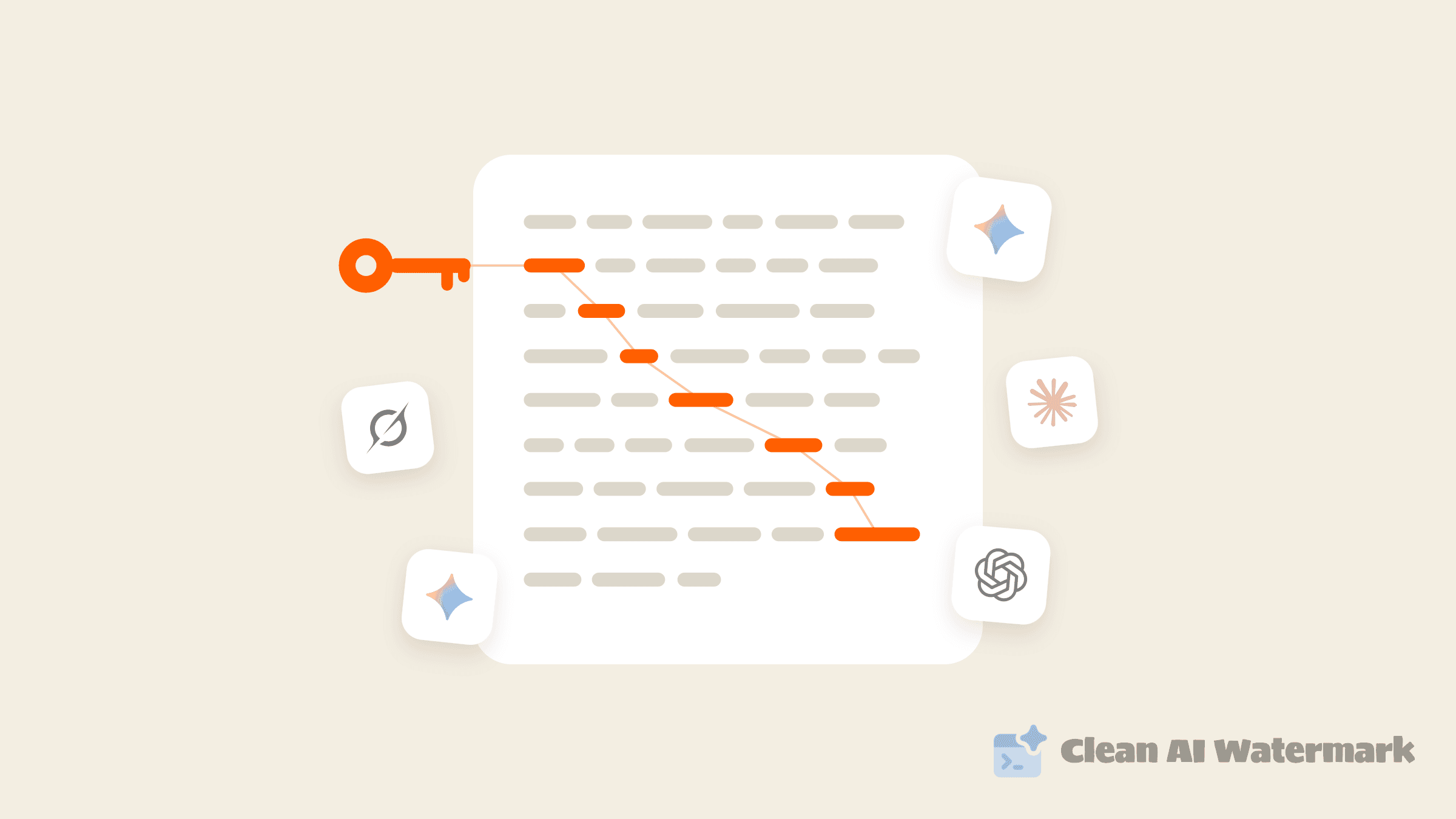
A text watermark is not a symbol that you can see or delete. While a model writes, it often has several words that fit equally well, and it picks one of them at random. A watermark replaces that random pick with a pick steered by a secret key. One steered word looks normal. Across a longer text, the steered picks add up to a statistical pattern that a detector with the same key can measure.
Google DeepMind described this method as SynthID-Text in Nature in October 2024. Anthropic says that Claude's watermark "is a version of the SynthID-Text approach" and that "nothing is added to the text and there are no hidden characters"1.
Two things follow from this design. The pattern stays when you copy and paste the text, change the font, or save it as another file type, because it lives in the words themselves. And only the company that holds the key, or an organization it gives access to, can check a text for it.
Does Claude watermark text?
Yes. Anthropic's help page lists text watermarks for Claude Fable 5.1, Mythos 5.1, Opus 5.5 and Opus 5. For models released before August 2, 2026, Anthropic is adding watermarks now, "with all covered by December 2, 2026".
Four details from Anthropic's announcement matter in practice:
- Translations: "A translation produced by Claude carries a watermark, because in this case every word is chosen by Claude."
- Code: the mark only goes where more than one choice is correct. Where a different term would break the code, "the watermark isn't applied".
- Short texts: detection "doesn't work well on small samples, where there are fewer word choices".
- Edits: "Light editing probably won't remove the watermark completely; a complete rewrite where every word is replaced will."
The watermark also has limits on what it proves. According to Anthropic, it shows that Claude was likely involved with a text at some point, but it cannot tell "Claude wrote this" apart from "Claude heavily edited this".
To clean text from these Claude models, paste it into our Claude watermark remover.
Does Gemini watermark text?
Yes, in the Gemini app. Google DeepMind announced in May 2024 that it was "expanding SynthID's capabilities to watermarking AI-generated text in the Gemini app and web experience". The Nature paper adds that "SynthID-Text has been used to watermark Gemini and Gemini Advanced" and reports a live test on nearly 20 million Gemini responses.
For the Gemini API, Google's documentation does not say either way. The SynthID page names only the Gemini app and web experience, so treat text from the API as unconfirmed.
Google is open about the limits. Its developer guide says that SynthID-Text holds up against "modifying a few words, or mild paraphrasing". The same guide warns: "Detector confidence scores can be greatly reduced when an AI-generated text is thoroughly rewritten, or translated to another language." It also says that the watermark "is less effective on factual responses", because a factual answer leaves the model fewer free word choices.
For Gemini text, use our Gemini watermark remover. The SynthID-Text remover takes text from any model that uses SynthID-Text.
Does ChatGPT watermark text?
Soon, but only in the EU. On October 5, 2026, OpenAI announced a text watermark called textGrain. It "adds an invisible statistical signal to the model's word choices", so, like the Claude and Gemini watermarks, it is a pattern in the words that only a detector with OpenAI's key can measure.
OpenAI's plan has three parts:
- ChatGPT and Codex: over the coming weeks, eligible text output on all plans gets the watermark, but only in the EU. OpenAI is not making it a global default at launch.
- The API: developers anywhere can turn the watermark on for select models. It is off by default.
- Detection: there is no public detector. Approved researchers and expert organizations can apply for access, and OpenAI decides case by case.
OpenAI also published the limits of its own watermark. At a 1% false positive rate, its detector found the mark in about 80% of 200-token passages and about 95% of 400-token passages, and much less often in math answers, where the model has fewer free word choices. Replacing 10% of the words with synonyms cut detection from about 92% to 66%, and replacing 25% cut it to 17%. OpenAI adds that a missing watermark does not prove that a person wrote a text. Our guide Does ChatGPT watermark text? covers textGrain in detail.
For images and audio, OpenAI's help page on provenance lists C2PA metadata and SynthID watermarks.
textGrain is not OpenAI's first text watermark. In an August 2024 update, it wrote that its method was "highly accurate and even effective against localized tampering, such as paraphrasing", but "less robust against globalized tampering; like using translation systems, rewording with another generative model". OpenAI also wrote that a text watermark "could stigmatize use of AI as a useful writing tool for non-native English speakers", and it put audio and video first.
In April 2025, Rumi reported narrow no-break spaces (U+202F) in text from newer ChatGPT models. Rumi wrote that OpenAI contacted them and said that the characters are not a watermark but "a quirk of large-scale reinforcement learning". A few days later, Rumi no longer saw the characters. This is Rumi's account; OpenAI has not published a statement of its own.
Our ChatGPT watermark remover deletes zero-width spaces and turns hidden spaces such as U+202F into normal ones.
What about Grok, Meta AI and Mistral?
Grok: the xAI FAQ says that images and videos from Grok carry a watermark. It says nothing about text, and we found no xAI statement about a text watermark. xAI is also not among the signatories that the European Commission lists for the EU code of practice on AI-generated content (see the last section).
Meta AI and Llama: Meta signed that code in July 2026. Its announcement talks about a detection tool for images made with Meta AI. We found no Meta statement about a text watermark.
Mistral: Mistral says that it is "actively working on implementing our obligations" and "will provide output marking and a detection solution in accordance with the Code of Practice by December 2, 2026". Vibe is the new name of Le Chat.
Are hidden characters a watermark?
No. Hidden characters, such as the zero-width space (U+200B) or the narrow no-break space (U+202F), are single characters in the text. An editor that shows invisible characters can find them, and you can delete them one by one. Text can pick them up from many places, such as web pages and word processors, without any AI involved.
A word-choice watermark is a different thing. Claude and Gemini put no extra characters into the text, so there is nothing to find or delete. If you delete the hidden characters from Claude or Gemini output, the word pattern stays exactly where it was. OpenAI describes textGrain in the same way, as a signal in the word choices.
Who can check a text for these watermarks?
Only a few organizations can check today:
- Claude: Anthropic's detection is "in private preview, available to eligible organizations as required under EU law (such as regulators, law enforcement, media, fact-checkers, independent researchers, educational organizations, and EU civil society groups)"2. So some schools and universities may be able to check a text for it.
- Gemini: Google has no public checker for Gemini text. The SynthID check in the Gemini app covers images, video and audio3, and the SynthID Detector portal runs on a waitlist for journalists, media professionals and researchers.
- ChatGPT: OpenAI has no public detector for textGrain. Approved researchers and expert organizations can apply for access, and OpenAI decides case by case. OpenAI's public verification tools check only images and audio.
- Your own models: the open version of SynthID-Text in Hugging Face Transformers detects only text made with your own watermarking key4. It cannot check Gemini output.
AI writing detectors such as Turnitin and GPTZero are a different kind of tool. They estimate from the style of a text whether a model wrote it. A watermark check does not guess from style; it needs the key of the company that made the model.
What weakens a text watermark?
The companies that publish text watermarks name the same limits:
- A full rewrite. Anthropic says that "a complete rewrite where every word is replaced will" remove Claude's mark. Google says that detector confidence drops when a text is "thoroughly rewritten". In OpenAI's test, replacing 25% of the words with synonyms cut detection of textGrain to 17%.
- Translation by another tool. Google and OpenAI both name translation as a limit. A translation that Claude itself writes still carries Claude's mark.
- Short texts. Anthropic, Google and OpenAI all say that detection needs longer text to be reliable.
- Factual text. When only one answer is correct, the model has no free word choice, so the mark has less room. OpenAI saw the same effect in math answers.
Light edits weaken a watermark much less. Anthropic says that light editing "probably won't remove the watermark completely", and Google says that its mark holds up against "modifying a few words, or mild paraphrasing". In OpenAI's test, a text with 10% of its words swapped was still detected about two times in three.
Why are AI companies adding watermarks now?
The EU AI Act. Its Article 50(2) says that providers of AI systems
generating synthetic audio, image, video or text content, shall ensure that the outputs of the AI system are marked in a machine-readable format and detectable as artificially generated or manipulated5
The rule applies from August 2, 2026.
A July 2026 amendment gives systems that were on the market before that date until December 2, 2026 to comply6. That is the date that Anthropic and Mistral name for their older models and their output marking.
To show how they meet the rule, about 190 organizations signed the EU Code of Practice on Transparency of AI-generated Content. For its marking section, the European Commission names Anthropic, Google, Meta, Microsoft, Mistral and OpenAI among the signatories7.
Because of the December deadline and the ChatGPT rollout, this table may change before the end of 2026. We will check the ChatGPT rollout again in late October, every source again in November and after December 2, 2026, and update this page.
Clean your AI text
Paste the text and click once. Clean AI Watermark strips hidden characters, rewrites the word choices, and keeps your meaning.
Sources
Company pages
- Anthropic: How Claude's text watermarking worksHow the Claude watermark worksChecked
- Claude Help CenterClaude models and detection accessChecked
- Google DeepMind: SynthIDGemini app and webChecked
- Google DeepMind blog, May 2024Gemini text since May 2024Checked
- Google AI for Developers: SynthIDLimits of SynthID-TextChecked
- Gemini Apps HelpSynthID check in the Gemini appChecked
- Google: SynthID DetectorSynthID Detector waitlistChecked
- Hugging Face: SynthID TextOpen SynthID-Text in TransformersChecked
- OpenAI: Our approach to EU text provenance rulestextGrain in ChatGPT, October 2026Checked
- OpenAI Help CenterImages and audioChecked
- OpenAI: Understanding the source of what we see and hear onlineOpenAI's text watermark, August 2024Checked
- xAI FAQGrokChecked
- Meta NewsroomMeta AI and LlamaChecked
- Mistral AI: Vibe WorkMistral VibeChecked
Research and reports
- Nature: Scalable watermarking for identifying large language model outputsThe SynthID-Text methodChecked
- Rumi: New ChatGPT models seem to leave watermarks on textHidden characters in ChatGPT text, April 2025Checked
Law and regulators
- Regulation (EU) 2024/1689Article 50(2)Checked
- Regulation (EU) 2026/1744New Article 111(4)Checked
- European CommissionCode of Practice signatoriesChecked